Tuesday, October 30, 2012

The Catacombs – Just Do Your Job


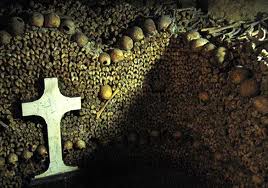
A few years ago, I traveled to Paris, France to attend my brother’s wedding. I was the typical tourist visiting the Eiffel Tower, the Louver and the Notre Dame Cathedral. One afternoon, I found the entrance to the Parisian catacombs. The catacombs are a labyrinth of passage ways and rooms used by gravediggers over hundreds of years to store the bones of the dead to make room in overcrowded cemeteries. It is entirely under the city with no street signs or sunlight. The French Resistance used these passageways to fight against the Germans in World War II. What struck me as I walked through the place was how the bones were stored. Piled six to seven feet high, they stayed in place with a retaining wall made entirely of femurs. Every wall of bones had a plaque attached that identified the cemetery where the remains were from and the years that the dead were buried before they were brought to this final resting place. 

What struck me as I walked through miles of boney passageways was how some gravediggers took time to build a wall with amazing attention to detail. They were committed to the task, placing one row of bones in a straight, level line and matched the row above it in the same way. They did their job. Others didn’t have the same level of commitment. Their retaining walls were below standards; barely good enough to hold back the remains of the long ago dead.  

One of my expectations for people at work is simply this: Just Do Your Job. There are standards for police officers, public safety dispatchers and first responders just as there were standards for gravediggers. In the catacombs, job performance was on display centuries after the job was complete. As Christians, our job performance is a testimony of faith and that testimony is timeless. It is the means by which we can share how our faith in God gives us strength to do our job even when the task is mundane, challenging or difficult. What does this testimony look like? Be content. Don’t grumble. Do all things to the glory of God.

Be Content

Jesus taught his disciples to be content and used a parable about work to drive the point home. Matthew 20 tells about a man who hired people throughout the day to work in his fields. Some worked twelve hours and others worked only two. When the labor was finished, he paid everyone the exact same wage. The men who worked all day were not content with what they received for their labor. People pay attention to how we react when things don’t go our way at work. Our attitude will be remembered long after an event fades into memory. Philippians 4:7, “And the peace of God, which surpasses all comprehension, will guard your hearts and your minds in Christ Jesus.

Don’t Grumble

It is in our nature to complain. It is easy to grumble about people who don’t work as hard as you, a “poor” decision made by the boss or a task that you really don’t like to perform. There are two things that you can count on at work: 1) Sooner or later everyone is going to let you down. 2) There will be tasks to do that you have no interest in completing. How should we respond in these situations? Philippians 2:14-15 “Do everything without grumbling or arguing, so that you may become blameless and pure, children of God without fault in a warped and crooked generation. Then you will shine among them like stars in the sky…”

Do All Things to the Glory of God

No matter if you are a peace officer or a Parisian gravedigger, we are called to do our job to God’s glory. Colossians 3:17 “And whatever you do, whether in word or deed, do it all in the name of the Lord Jesus, giving thanks to God the Father through him.” Job performance can be a powerful testimony. We can demonstrate patience and kindness. We can offer protection and perseverance. We can show grace by keeping no record of wrongs. 

A few years ago, I worked with a man who did not know Christ. We did not interact very much except for a hallway greeting here or there and short conversations in the report writing room. He eventually went to work for another police department. Last year, he became a Christian and attended the church where I sing on the worship team. He told a pastor that although we never really interacted, he could see there was something different about how I did my job. It was not until he saw me leading worship that it fit together. James wrote that faith without works is dead. I will borrow this observation with a small change of context. Work with faith and live! You never know who is watching...

Sunday, October 14, 2012

Dying Declarations


A dying declaration is a statement made by a person about to die (or thinks they are about to die). It is admissible in court as an exception to the hearsay rule. A person’s last words. When Jesus went to the cross, he went there with two other men. All three had things to say. Luke 23 records this dialogue while they died by crucifixion.

Two other men, both criminals, were also led out with him to be executed. When they came to the place called the Skull, they crucified him there, along with the criminals—one on his right, the other on his left. One of the criminals who hung there hurled insults at him: ‘Aren’t you the Messiah? Save yourself and us!’ But the other criminal rebuked him. ‘Don’t you fear God,’ he said, ‘since you are under the same sentence? We are punished justly, for we are getting what our deeds deserve. But this man has done nothing wrong.’ Then he said, ‘Jesus, remember me when you come into your kingdom.’Jesus answered him, ‘’”

Some think this man lived a criminal life and made a last second plea for grace. Live now, cry later. The guy got away with murder! How could a man like THAT get into heaven? I think was more to this dying declaration than meets the eye.

It's likely that both of these condemned men spent time in jail before they hung on a cross next to Jesus. In fact, it would make sense that they heard about Jesus long before they got to Calvary. Consider that John the Baptist was arrested and tossed into the Fortress of Machaerus about 14 miles from Jerusalem by King Herod. John remained in custody from the time Jesus started calling his first disciples until he was executed. John started the first prison ministry.

I wonder if these men were in the same prison as John. One man listened to John's message, the other mocked it. John proclaimed the forgiveness of sin and salvation for all. He taught about the man called Jesus and offered a testimony about what happened when he baptized Jesus. Guilty of nothing other than making a king's wife angry, he was a voice calling in a wilderness of convicts.

The two criminals would eventually be brought to Jerusalem. Roman soldiers took them to a hill and carried out the death sentence. Where these men were accompanied by a detachment of soldiers, a crowd followed Jesus. Each man was nailed to a cross and lifted up to die. The hours passed and both men confessed that Jesus was the Messiah. One taunted the Savior, called on Him to join a conspiracy and save only him. The other admitted guilt and accepted his death sentence. He asked simply for Jesus to remember him. Jesus would do more than remember. "Truly I tell you, today you will be with me in paradise."

We will all make a dying declaration. What remains is which condemned man would we be?

Tuesday, September 18, 2012

RED TAGGED!


Building inspectors get a bad rap. Where a cop can take away an individual’s freedom, a building inspector can halt a construction project in its tracks. It has never occurred to me to tell a driver during a traffic stop, “Sir, your driving was not up to code.” If the purpose of traffic enforcement is to reduce traffic collisions, then the purpose of a building inspection is to keep structures standing during catastrophes. If you watch news coverage of disasters where safe building standards are non-existent; you can see the consequences. 

Here is a spin on Romans 13: “Let everyone be subject to the Building Inspectors, for there is no Building authority except that which God has established. Building Inspectors that exist have been established by God…For Building Inspectors hold no terror for those who do right, but for those who do wrong. Do you want to be free from fear of the one in authority? Then build according to code and you will be commended. For the one in authority is God’s servant for your good. But if you do wrong, be afraid, for Building Inspectors do not bear the Red Tag for no reason.”

God himself issued the first Red Tag in Genesis 11. The grandchildren and great-grandchildren of Noah shared a common language and speech. They traveled together and set up house on the Plain of Shinar. Someone figured out that bricks were easier to produce then finding and digging up rocks as building materials. Standards fell and tar replaced more stable forms of mortar. Then the pride of ownership got the best of them. Genesis 11:4 “They said, ‘Come, let us build ourselves a city, with a tower that reaches to the heavens, so that we may make a name for ourselves; otherwise we will be scattered over the face of the whole earth.’”

God delights in the humility of man but opposes the proud. These people did not get it. In fact, they wanted to make a name for themselves and they were willing to take short cuts to do it. Apparently resting on the name of God was not enough. Scripture says that God “came down” to see the city and the tower. He saw that they were, once again, on a path to destruction. He Red Tagged the tower and the city buildings by confusing their language causing them to scatter all over the earth. 

Have you ever experienced a time where there was confusion of purpose? A meeting where people were not getting it and frustration follows? It happens at church, at family gatherings or in the workplace. Things just don't click; decisions are difficult to make and there is no consensus in the group. Sometimes we allow our personal agendas to get in the way of the good that God wants for us. We might be well intentioned but our decision making leads us down the wrong road. Proverbs 19:21 says this, “Many are the plans in a person’s heart, but it is the Lord’s purpose that prevails.”

Here is where I believe God comes alongside. He gives us peers, mentors and pastors to guide us in our churches, our families and at work. He gave us the Holy Bible as a blueprint to know and understand His purposes. He inspects and tests our work, sometimes by fire (literally and through the trials of life) to bring us back to our calling as sons and daughters of Christ. Even the Apostle Paul got a few Red Tags on his missionary journeys: “Paul and his companions traveled throughout the region of Phrygia and Galatia,having been kept by the Holy Spirit from preaching the word in the province of Asia. When they came to the border of Mysia, they tried to enter Bithynia, but the Spirit of Jesus would not allow them to.” (Acts 16:6-7)

Where is God telling you to scrap a project, stay status quo or rethink your plans? When our foundation is built on sand, bad things happen when storms blow through. God speaks to us through scripture, friends, and sermons. If you don’t listen, He gets a little louder. Perhaps it is through a poor performance evaluation at work or a marriage counselor telling you to listen to your spouse. If you continue to resist, He will Red Tag you! Better to inspect your own buildings and consider your ways before God has to do it for you!

Tuesday, September 11, 2012

Remember, Honor and Support

Today marks the anniversary of the 9-11 Attacks. I offer this reflection in honor of the lives lost on this day and to the men and women who gave their lives to protect ours in the days and years that followed; both here at home and overseas.

Consider this passage from the Gospel of Matthew Chapter 4, Verses 18-22, The Calling of the First Disciples:

“As Jesus was walking beside the Sea of Galilee, he saw two brothers, Simon called Peter and his brother Andrew. They were casting a net into the lake, for they were fishermen. ‘Come, follow me,’ Jesus said, ‘and I will make you fishers of men.’ At once they left their nets and followed him. Going on from there, he saw two other brothers, James son of Zebedee and his brother John. They were in a boat with their father Zebedee, preparing their nets. Jesus called them, and immediately they left the boat and their father and followed him."

As I think about the call if these men, it occurs to me that although Peter, Andrew, James and John immediately left to go with Jesus, they did not do so simply because a man they had never met walked up to them and said “Follow me.” These were men of faith who had read scripture and were watching for the opportunity to serve.

The call to become a peace officer is not made in a moment, in response to a job flyer or from watching commercial on television. It is a process that begins with a heart to serve others. The call means making a commitment of time, effort and sacrifice. We endure the testing process and background examinations, police academies and Field Training Officers.

We commit to work weekends, holidays and shifts. We stand at an intersection in the freezing rain with a flare pattern and our patrol car blocking a roadway with all the lights on and still have the patience to answer the question, “Is this road closed?”

We commit to stand firm in the face of every profanity and stop fighting when the other guy quits even if he got in more shots in than us. We commit to put our own life at risk to save another human being no matter who they are.

We also accept that what we do means that we may be called to lose our lives so that others will be safe. And it is not a decision we make for our selves but a sacrifice that our families live with as well.

For the men and women we remember today, it means their wives, husbands, children, parents, brothers and sisters will not see them again in this world. The men and women that served with them will carry the pain of the loss of a friend and a partner. Those that follow behind now live to honor a fellow peace officer who died in the line of duty.

The Book of Romans, Chapter 13, Verse 4 says of those that are called to keep the peace:

“For he is God's servant to do you good. But if you do wrong, be afraid, for he does not bear the sword for nothing. He is God's servant, an agent of wrath to bring punishment on the wrongdoer.”

Our call to police service means that we commit to protect the weak and hold evil at bay. We do this with the sword.

This is why our call is for very few. We must decide and act in a moment. We must understand the seriousness of our mission and what lies in the balance. We are fair yet firm, strong yet compassionate, we are brave in the face of danger when others will freeze or run away. We do this knowing that the cost might be our own lives for the benefit of our fellow man.

The Gospel of John Chapter 15:9-19 says this,

"As the Father has loved me, so have I loved you. Now remain in my love. If you obey my commands, you will remain in my love, just as I have obeyed my Father's commands and remain in his love. I have told you this so that my joy may be in you and that your joy may be complete. My command is this: Love each other as I have loved you. Greater love has no one than this, that he lay down his life for his friends. You are my friends if you do what I command. I no longer call you servants, because a servant does not know his master's business. Instead, I have called you friends, for everything that I learned from my Father I have made known to you. You did not choose me, but I chose you and appointed you to go and bear fruit—fruit that will last. Then the Father will give you whatever you ask in my name. This is my command: Love each other.

If the world hates you, keep in mind that it hated me first. If you belonged to the world, it would love you as its own. As it is, you do not belong to the world, but I have chosen you out of the world. That is why the world hates you.”

On September 26, 1929, two men entered a Rodeo bank near the Town of Pinole, armed with guns. They intended to rob the $27,000 payroll delivered that morning. Constable Arthur Mac Donald was also in the bank and confronted the robbers. A gun battle erupted. Although he managed to shoot one of the suspects, a third man driving a get away car fired into the bank from outside. Constable MacDonald was shot and mortally wounded. He was taken to the hospital in an attempt to save his life.

Although his wife managed to get to the hospital before he died, she was not allowed to be with her husband even though he called to her from the treatment room.

Constable Arthur Mac Donald was my great-grandfather. My grandmother received a telegram in New York at 5:40PM that evening that read,

“YOUR FATHER KILLED THIS MORNING HOLD UP RODEO BANK”

My grandmother told me that my great-grand father was a committed father and husband. A great aunt told me that she was proud that I followed in his footsteps. He served as a constable for 11 years. A man later told reporters that, “Jerry was a great man and popular, but if you got out of line he’d kick you in the butt and tell you to get off the street and go home. And you would do it too.”

If it was only still that easy.

When a member of our profession is killed in the line of duty, it has a profound impact on us as we live our lives by honoring their memory through our service in law enforcement. The impact becomes even more significant when we knew that the person behind the badge and realize they were committed to family, to the community and to their faith.

May God bless those that serve and the families support them. May God comfort those left behind.

Saturday, August 25, 2012

The Short Straw


Hebrews 11:1-3, “Now faith is confidence in what we hope for and assurance about what we do not see. This is what the ancients were commended for. By faith we understand that the universe was formed at God’s command, so that what is seen was not made out of what was visible.”

A cool thing about being a cop is meeting people that I would otherwise never encounter. I am not talking about "famous" people, I mean the support people who surround them. These are the individuals that make things happen and it’s interesting to hear their stories. A few weeks ago, I coordinated security for a high ranking member of the current administration. This leader was the keynote speaker at a national conference held in my city and members of the police department were assigned to the perimeter of the venue. After things got settled and the keynote address began, I walked through the building to check on the officers to see how they were doing.

Moving through the reception area, I spotted a stocky, young man standing off to the side with a bag slung over his shoulder. He was dressed in a suit and unobtrusively watched the latecomers milling around the area. I walked over and introduced myself and asked what his role was at the conference. He said that he was the guy with the phone responsible to get to “the boss” any time it rang. There really is a Bat Phone! He was the ASAP-RT person. As Soon As Possible – Right Now, 24 hours a day, 7 days a week. It didn’t matter what was going on, the location or the time of day; this dude’s job was to interrupt "the boss" and hand him the telephone. It is fast paced job with lots of travel. We were killing time as the speech went on and I asked him to tell me one of his most memorable stories. It was a great lesson about faith. 

On one particular July 4th, his team was working in Cape Cod when a call came from a supervisor asking how long it would take to pack up, travel to Boston and set up communications at a downtown hotel. Cape Cod is 90 miles away from Boston and considering it was a July 4th Saturday, driving time alone would take over 2 ½ hours not including tearing down and packing; unpacking, set up and testing. He told the supervisor it would take at least five hours. The supervisor said he had three. 

“Impossible.”

“Well you guys are the only ones available so get moving.”

The call ended.

Needless to say the mad scramble began. Equipment got torn down and piled in the back of a vehicle; the Saturday afternoon, July 4th drive to Boston began. Traffic was a mess and the only way to meet the three hour deadline was to drive on shoulders, through grass causeways and to snake along break down lanes. One member of the team was busy securing equipment in the back of the unmarked van with another calling ahead to the various police departments to let them know a “reckless” driver was barrelling though their jurisdiction. They got a police escort only after they reached the Boston city limits.

As the team pulled in front of the hotel, the person they were tasked to provide Bat Phone communications for pulled in right behind them. This was not a drill. My friend described how they were lifting tables and equipment through a second floor window to save time. Computers were booted up, cables were connected, phones plugged in and secure wireless links established; it all came together in record time. Only one critical task was left. Set up a satellite dish on the roof of the hotel. One problem: a lighting storm was rolling through the area and no one could find the stand for the dish. Someone would have to get up on the roof and hold the dish until the stand was found. They drew straws; guess who pulled the short one? Up the stairs my friend went and stood out on the roof of the hotel holding a satellite dish in the middle of a lightning storm.

“I don’t care who you are, you will believe in God when you do that!”

The good news is that believing in God is not predicated on pulling the short straw and becoming a human lighting rod. Ephesians 2:8-9 says, “It is by grace you are saved through faith and it is not of yourselves, it is a gift from God – not by works so that no one can boast.” Jesus said in Matthew 17 that all we need is faith the size of a mustard seed and we can move mountains. I will take sowing a small seed of faith over discovering God that exists by holding a big circle made of metal in the middle of a lightning storm!

Friday, July 6, 2012

The 10 Rule of Decision Making


James 3:18 “Peacemakers who sow in peace reap a harvest of righteousness.”

What does it mean to “sow in peace”? I see it in police officers that show up at domestic disputes and have the skill to calm people down who are out of their minds in anger. I hear it in the voice of a 911 dispatcher who assures the driver injured in a traffic collision that help is on the way. It is the ability of a correctional officer to talk down a drunk who wants to pick a fight at jail. It is apparent in criminal justice managers and executives who take time to consider the impacts of policy decisions before they implement them. Sowing in peace is thinking before you act; listening, watching body language and connecting with people. Scripture gives us the roadmap:

Galatians 5:22-23But the fruit of the Spirit is love, joy, peace, patience, kindness, goodness, faithfulness, gentleness, self-control; against such things there is no law.”

Proverbs 10:19 “Sin is not ended by multiplying words, but the prudent hold their tongues.”

James 1:19 “My dear brothers and sisters, take note of this: Everyone should be quick to listen, slow to speak and slow to become angry, because human anger does not produce the righteousness that God desires.”

2 Peter 3:9The Lord is not slow to fulfill his promise as some count slowness, but is patient toward you, not wishing that any should perish, but that all should reach repentance.”

The practical application of this is The 10 Rule of Decision Making; take time to think, consider what is going on around you and seek guidance through counsel, training and prayer. The amount of time you have is entirely dependent on the circumstances. Generally (and using a law enforcement rank structure) I figure that police officers have about 10 seconds to make decisions, police sergeants have 10 minutes, lieutenants get 10 hours, commanders get 10 days and police chiefs get 10 weeks. The point is that the higher go in an organization, the longer your decision making process can take. I believe that the same is true in parenting, leadership, and living the Christian life. Maturity and experience bring with it a responsibility to master patience.

But wait! There’s more! How long does it take to master a skill? The “experts” suggests it takes 10,000 hours. Based on a 40 hour work week, it takes 4.8 years to become proficient. George MacDonald, a predecessor and theologian of significance in the life of C.S. Lewis, wrote that it is better to watch corn grow than to experience a miracle. He said that God has already created everything and we have the privilege to discover it. Philippians 4: 6-7 adds this, “Do not be anxious about anything, but in every situation, by prayer and petition, with thanksgiving, present your requests to God. And the peace of God, which transcends all understanding, will guard your hearts and your minds in Christ Jesus.